Buyer's Guide
How to Buy Fasteners for Insulation & Metal Jacketing
Screws, nails, hog rings, and D-rings each solve a different fastening problem. This guide walks the three decisions that matter — point style, material, and head/washer — so you can order the right fastener for the substrate and the service environment.
For Informational Purposes Only
The fastener selection information in this guide is general reference material provided for informational purposes only. It is not a technical specification, engineering instruction, or approved procedure, and figures shown are typical values rather than guaranteed or design limits. Always follow the project specifications, the manufacturer's installation instructions, and applicable building codes, and consult a qualified professional for your application. American Wire Works assumes no liability for any selection, installation, or use made based on this content.
Start with the job, not the screw
Choosing a fastener comes down to three questions. First, what are you fastening into — light-gauge jacketing, sheet metal, fabric and mesh, or temporary lumber? That decides whether you need a drilling screw, a closure ring, an anchor, or a nail. Second, what is the service environment — outdoor, damp, or corrosive service calls for stainless; dry indoor or temporary work does not. Third, does the penetration need to seal — weather-exposed jacketing wants an EPDM-washer head. Get those three right and the specific size follows. The sections below cover each fastener we supply and the trade-offs behind each decision.
The four fastener types we supply
Our fastener line is built around mechanical insulation, metal jacketing, and removable blanket fabrication. Start with the form that matches your job, then choose material and size.
Self-Tapping & Self-Drilling Screws
410 stainless screws for jacketing and sheet-metal securement
The workhorse fastener for mechanical insulation and metal jacketing. Available in both self-tapping (needs a pilot hole) and self-drilling TEK (bores its own hole) point styles, in 410 stainless so they penetrate jacketing without sacrificing corrosion resistance. A slotted indented hex washer head drives fast and holds the bit; EPDM washer options seal the penetration on weather-exposed closures.
Point style drives the choice: self-drilling saves a drilling step on solid jacket runs, self-tapping is the pick when the material is pre-punched or too thin to need a drill point.
Best For
- Aluminum and stainless metal jacketing over insulation
- Outdoor and weather-exposed closures (with EPDM washer)
- Light-gauge sheet metal securement
- Field installs where screws must stay on the driver bit
Duplex Nails
Double-head nails for temporary construction and easy removal
Duplex (double-head) nails are driven to the lower head, leaving the upper head proud so they pull cleanly when the temporary work comes down. Supplied in 8D and 16D sizes, they are the standard fastener for forms, cleats, bracing, and temporary insulation support — anywhere you need a nail that comes back out.
Best For
- Temporary construction and form work
- Jobsite bracing and cleats
- Insulation support that will be stripped later
- Any repeat-access or removable install
Stainless Steel Hog Rings
SS304 closure rings for blankets, mesh, and dense jackets
The fast, repeatable closure for removable insulation blankets, dense fabrics, and mesh systems. SS304 construction stands up to damp service where galvanized rings would rust, and polyester-tape collation feeds smoothly through a pneumatic ringer with less residue than glued formats. Supplied in 1/2 inch and 3/4 inch ring sizes — choose the ring by the closure diameter and material thickness.
Best For
- Removable insulation blanket fabrication
- Wire mesh assembly and heavy jacket closures
- High-volume, repetitive production work
- Damp or corrosive service environments
Stainless Steel D-Rings
Welded stainless anchors for straps and lacing
A standard anchor point in removable insulation pad and blanket fabrication. Welded-end construction resists opening under strap tension — more secure than split-ring alternatives — and the stainless alloy holds up in corrosive, high-moisture conditions. Supplied in 1 inch and 1-1/2 inch sizes to match your strap width and closure hardware.
Best For
- Removable insulation pads and blankets
- Strap, hook, and lacing anchor points
- Corrosive and high-moisture service
- Reusable covers that see repeated closure cycles
Decision 1: self-tapping vs self-drilling
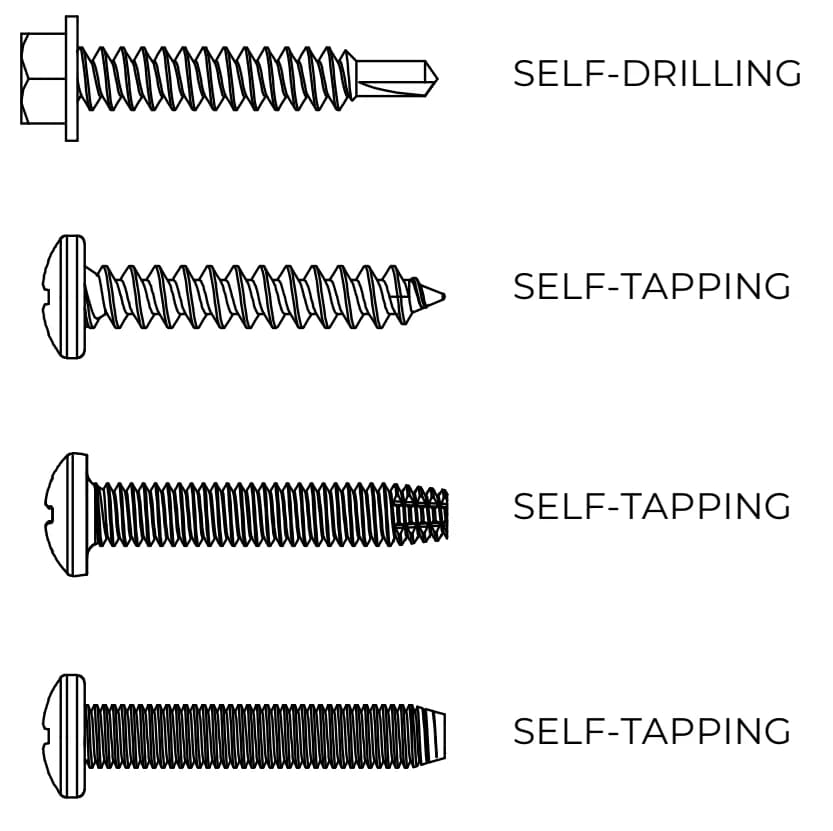
The point style decides whether you drill a pilot hole first. Match it to your substrate and how the material is prepped.
| Point Style | Point | Pilot Hole | Best Use |
|---|---|---|---|
| Self-Tapping | Sharp tapping point | Pilot hole required | Pre-punched or thin sheet; fastening into existing holes |
| Self-Drilling (TEK) | Drill-bit point | No pilot hole | Solid jacket runs and sheet metal in one pass |
Decision 2: which material
Corrosion resistance and hardness pull in opposite directions. The alloy that drills through jacketing is not the one you want for closure hardware — which is why each fastener uses a different material.
| Material | Character | Used For |
|---|---|---|
| 410 Stainless | Hardenable, magnetic, strong | Self-tapping & self-drilling screws — drills and taps through jacketing |
| 304 Stainless | High corrosion resistance, softer | Hog rings & D-rings — closure hardware, not drilling |
| Zinc / bright steel | Low cost, no corrosion barrier | Duplex nails — temporary, indoor, short-service work |
Choosing fasteners by application
Mechanical insulation jacketing
Metal jacketing over pipe and equipment insulation is closed with 410 stainless self-drilling or self-tapping screws. Add an EPDM-washer head on any outdoor or weather-exposed run so the penetration stays water-tight.
Removable insulation blankets
Blanket fabrication pairs SS304 hog rings for fast fabric-and-mesh closure with welded stainless D-rings as strap and lacing anchor points. Both resist the moisture and heat that would corrode plated hardware.
Sheet metal & light structural
Light-gauge sheet and structural members take self-drilling TEK screws for a one-pass install. Match screw length to substrate thickness so you get full thread engagement without over-driving.
Temporary construction
Forms, cleats, and temporary bracing use duplex nails — the double head pulls cleanly when the work comes down. Size 8D or 16D based on the substrate and the holding depth you need.
Practical tips for buying fasteners
- Match the screw length to the substrate. You want full thread engagement past the back of the material without over-driving and stripping the hole. Give us the jacket material and gauge and we will size it.
- Add an EPDM washer for weather-exposed closures. Any penetration through outdoor jacketing should seal — the EPDM washer compresses under the hex head to keep water out and dampen vibration.
- Don't over-spec closure hardware. Welded D-rings and stainless hog rings are built for corrosive, high-cycle service — for a low-cycle indoor blanket, a lighter closure may be all you need.
- Confirm tool compatibility before you order rings. Tape-collated hog rings feed a pneumatic ringer smoothly — verify the ring size matches your tool and the closure diameter of the material.
Related products
Browse the self-tapping & self-drilling screws, stainless steel hog rings, stainless steel D-rings, and duplex nails, or see the full fasteners category.
Frequently asked questions
What is the difference between self-tapping and self-drilling screws?+
Why choose 410 stainless for insulation screws instead of 304?+
What fasteners are used to close a removable insulation blanket?+
What size self-drilling screw do I need for metal jacketing?+
Not sure which fastener to order?
Tell us the substrate, the environment, and the closure — we'll spec the right screw, ring, or anchor. Family-owned since 1940, we turn quotes around same-day. Call (215) 744-6600.